
Successful trapping of any AH Queens that may have overwintered here in Ireland and that may be emerging, will remove the need to track, locate and remove their nest later in the season. Each undetected nest that goes to the end of it’s natural lifecycle can produce up to 300-500 gynes, (virgin queens), that will mate and hibernate to emerge the following spring.
The modifications to the Vespa traps being supplied by the IBA, have been developed through a collaboration between the IBA and Mr. Paul Prouten on the island of Jersey. Paul has gained considerable experience in dealing with the Asian Hornets, since they first arrived on the island in 2017.
The adaptations convert the standard Vespa Catch trap, from a “kill” trap, to a “live” trap, while significantly reducing the amount of bycatch of other pollinators. These traps and this adaptation is the preferred method currently used by Jersey volunteers.
A wick assembly has been introduced, to prevent insects from being drowned in the liquid attractant. Two holes have also been made in the sides of the trap, to allow other pollinating insects to escape, while preventing the escape of the trapped Asian Hornet.
3D printed entrance reducers, made from a biodegradable PLA plastic, are inserted into the entrance holes to reduce the two 14mm entrance holes to 8.2mm. These have recently been tested in Jersey by Paul, and they are just big enough to allow Asian Hornet Queens to enter the trap, while simultaneously reducing the trapping of other beneficial bycatch, such as bumble bee queens.
To maintain the traps’ ability to lure the Asian Hornets by allowing the aroma of the attractant vapour to escape, extra holes have been laser cut in the lid of the trap. The lure or bait used can be made up locally and is readily available; see recipe below. It is very successful and is used in Jersey and was used in Cork, along with Trappit, a commercially supplied, but pricey lure.
Important guidance for trap use
These traps are supplied on the understanding that the users will check them daily to ensure the release of any bycatch too big to escape the escape holes.
WE DO NOT WANT TO ADD TO THE DAMAGE THAT ASIAN HORNET PREDATION DOES TO INDIGENOUS POLLINATORS BY INDISCRIMINATE TRAPPING / KILLING OF BENEFICIAL INSECTS.
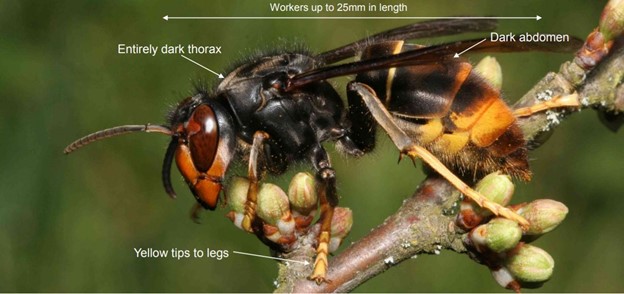
RECIPE FOR ASIAN HORNET BAIT/LURE AS SUPPLIED BY JERSEY VOLUNTEERS.
1kg sugar
2 litres boiling water
2 tablespoons blackberry jam … pushed through sieve with spoon into boiling water
1 teaspoon baker’s yeast ONLY to be added when the mixture has cooled. The fermentation starts to tail off after a couple of weeks, but it keeps working well for up to three weeks. Note that whilst fermentation is ongoing, please do not seal the container as the gasses being created could cause it to explode. Only use the bait after at least three days as per previous slide.
Do not overfill the trap. The wick insert in each trap allows for the aroma to attract any AH queens but ensures that no insects accessing the traps will drown.
Should you find an AH queen in your trap, please take a photograph and report it to www.invasives.ie
Placement advice
Do not site traps near your bees or in your apiary. You do not want to attract any Asian hornets that may be around, to your bees.
A video on how to assemble the traps is available to watch at this link: https://irishbeekeepers.ie/confirmed-asian-hornet-sightings-in-cork-beekeepers-urged-to-act/
Further information from pro@irishbeekeepers.ie